

By Theodore Johnson
The Philadelphia Tribune
https://www.phillytrib.com/
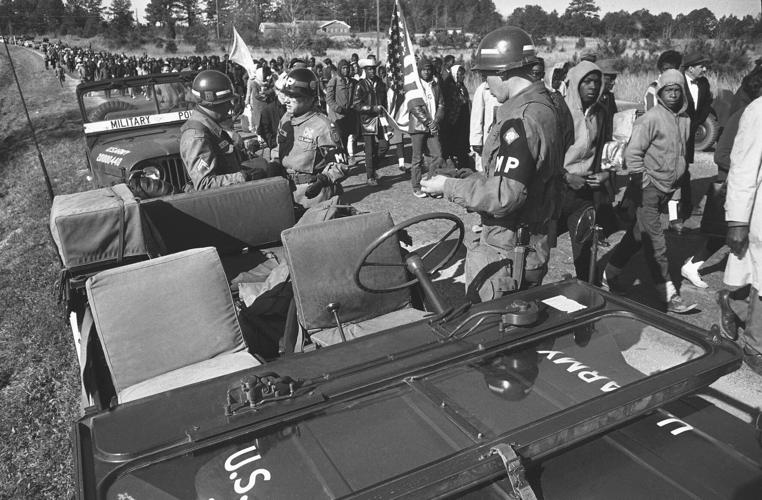
-AP PHOTO
When law enforcement surges against protesters, it produces a scene recognizable to most Americans: clouds of tear gas, swinging batons and police dogs lunging as people are knocked down. It could be anywhere. In South Minneapolis today. In Selma, Alabama, in 1965. The people and causes are different, but the reason is the same — when some citizens demand accountability, they are met instead with violence. The government is most unrestrained toward those it feels least obligated to protect.
Historian Carter G. Woodson witnessed this violence during the “red summer” of 1919, a season of racist vigilantism and police brutality aimed at Black workers, veterans and communities insisting on equal rights. At a time when souvenir postcards of lynching photos were mailed regularly, he believed the stakes were existential. “If a race has no history,” he warned, “it becomes a negligible factor in the thought of the world, and it stands in danger of being exterminated.”
For this reason, one century ago this week, Woodson launched Negro History Week, the precursor to Black History Month. He considered history to be a ledger — it affirmed for Black people that their claim to full citizenship was righteous and reminded the United States that equal protection was its obligation. It suggested the political status of Black Americans is the truest measure of the republic and the health of our democracy.
The balance of power between the people and government has always been contested here. Many of the Constitution’s authors did not trust the public, considering them liable to “temporary errors and delusions,” as James Madison wrote in the Federalist Papers. Alexander Hamilton declared, “The people are turbulent and changing; they seldom judge or determine right.” Accordingly, the founders designed a democratic republic, structured to filter the voice of the people through institutions controlled by elites. Yet the nation’s founding documents and exemplars promised something more: a government of, by and for the people, one that derives its “just powers from the consent of the governed.”
This is the founding contradiction: Our democracy was designed with mistrust of the people in mind. Making the United States into this more perfect Union requires the reconstruction of our republic — to better represent, and more faithfully serve, the people. Even the ones who protest it. Even the ones it once enslaved.
Need better perspective
Black History Month is sometimes treated like a curated gallery of Black people’s American exceptionalism, filled with superlative figures and achievements. But it is better understood as a record of public resistance and national progress, created to commemorate Black Americans’ role in shaping the country. America’s values are always tested when it must seek the consent of people it once excluded and share power with them. In this way, Black history is a definitive measure of the nation’s progress and capacity to live its creed.
At the nation’s founding, the principles of equality, liberty and democracy were withheld from Black Americans. Congress and the Supreme Court determined they were property and without constitutional rights. The transition from slavery to citizenship was not a peaceful one; it required civil war. Reconstruction followed, not only as a period to rebuild the country’s infrastructure but as an opportunity to restructure the republic. And yet, even war and three constitutional amendments — the 13th, 14th and 15th, known as the Reconstruction Amendments — did not deliver the equal protection or voting rights they promised. For Black people, the transition from citizen to voter stalled and would take nearly another century.
Drawing on the courage of civil rights activists in 1965, President Lyndon B. Johnson sought to complete this evolution. He compared the Selma marches to the country’s wars for independence and reunification. “The real hero of this struggle is the American Negro,” he told a joint session of Congress, continuing, “His demonstrations have been designed to call attention to injustice, designed to provoke change, designed to stir reform.” The Civil Rights Act of 1964 and the Voting Rights Act of 1965 reconstructed the republic once more by strengthening constitutional guarantees of equal protection, finally making Black citizens into voters.
The change wasn’t easy. It produced more civil unrest as the public demonstrated against a government that was insufficiently representative. During the “long, hot summer” of 1967, newly enfranchised Black Americans protested continued police brutality and socioeconomic inequality. The next year, the Rev. Martin Luther King Jr. was assassinated; more protests, riots and state-approved violence ensued. And the dissatisfaction extended beyond Black Americans and civil rights — in 1970, the National Guard killed four students at Kent State University during a demonstration against the Vietnam War.
Black history teaches that the republic’s deepest structural flaws are exposed whenever violence is used to silence citizens. And that the source of those flaws is a government unaccountable to the people.
Due for reconstruction
Over the past year, the number of demonstrations against executive overreach has surged. In some places, public protests of the government’s secretive deportation operations turned violent. Even as democracy has become more accessible, dissatisfaction with government lingers. People are unhappy with the republic and anxious about its politics; it’s overdue for reconstruction.
The founding generation built a democratic republic that insulated government from its constituents. The president would be chosen in the electoral college, not by the people. U.S. senators would be chosen by the state legislatures, not by the people. Only Congress could remove the president, one of its members or a Supreme Court justice, not the people. That structure, and the thinking that created it, is outdated.
There have been tweaks, and it is time for more. Between 1913 and 1964, constitutional amendments were ratified that established the direct election of senators, suffrage for women, electoral college votes for D.C and the abolition of the poll tax. Today, the republic should likewise be made more democratic: The electoral college should award its votes based on a candidate’s share of each state’s popular votes; the impeachment process should be revised to require bipartisan consensus with easier convictions and removals from office; legislation should be enacted to curb presidential abuse of emergency powers and ensure the presidency does not have absolute immunity; and Congress should be much larger — maybe triple its size — and partisan gerrymandering outlawed.
The journey of Black Americans from slavery to citizenship to voter — and the expanded access to democracy and opportunity for citizens of all backgrounds that occurred alongside — is the signal achievement of the U.S. It is evidence that our republic can be bent toward the public will and its professed ideals of equality, liberty and opportunity. And it also proof that a government fearful of losing power will go to extraordinary lengths to keep it. It will use the courts, executive orders and a passive Congress to avoid accountability. It will even use the long, baton-swinging arm of the law.
The lesson of Black history is that preventing republican institutions from clawing back democratic gains and making government more responsive requires vesting more authority in more citizens. The founders trusted the character and goodwill of elite men to govern the lives of people with little or no voice. Protests today in Minnesota — and in Selma in 1965, and in many, many other places — demonstrate that the founders’ faith was misplaced. Only the reconstruction of our republic will compel the nation to keep its promises to us all.
Protest movements expose government overreachTheodore Johnson, a contributing columnist for The Washington Post and retired naval officer, writes on issues of race, democracy, and American identity. He’s the author of the book “If We Are Brave.”

