

By Sarah Bahari
Dallas Morning News
https://www.dallasnews.com/
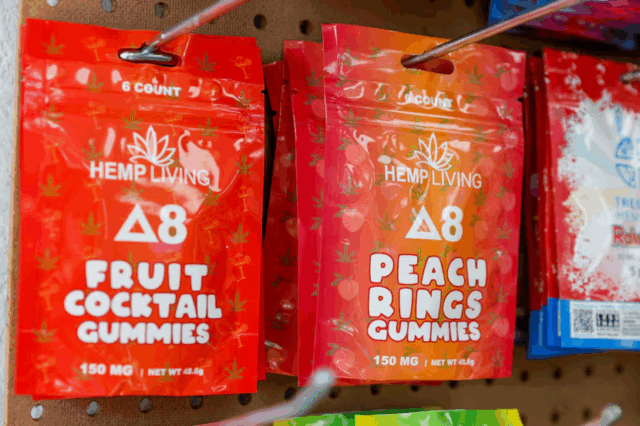
Elias Valverde II / Staff Photographer
President Donald Trump signed a bill Wednesday that bans nearly all THC products, just months after the Texas hemp industry narrowly defeated a ban at the state level.
Tucked into the spending bill to end the government shutdown, the legislation bans popular THC products like edibles and beverages. The products are set to disappear from store shelves in one year.
Members of the hemp industry in Texas and across the country criticized the ban, saying it would wipe out thousands of jobs and millions of dollars in tax revenue.
Here’s what to know about the law.
What is being banned?
Under the law, products with more than 0.4 milligrams of THC, the psychoactive compound found in marijuana, will be banned. Common ones include compounds known as delta 8 and HHC.
The change reverses provisions in the 2018 farm bill, which created a loophole that allowed the hemp industry to flourish. In recent years, THC-infused drinks, gummies, snack foods, vapes and other products exploded in popularity and became mainstays in smoke shops, convenience stores, grocery stores and coffee shops.
The law still allows the sale of products with less than 0.4 mg of total nonsynthetic THC per container, but those items are rare.
Why is it being banned?
U.S. Sen. Mitch McConnell, a Kentucky Republican who authored that 2018 farm bill, is a leading proponent of closing the loophole in federal law, arguing that companies have exploited it to create intoxicating substances.
Before the deal passed, U.S. Sen. Rand Paul attempted to remove that provision to protect farmers and small businesses. The Kentucky Republican said the issue should be studied separately and not tucked into a spending bill.
U.S. Sen. Ted Cruz was the only other Republican in the Senate to vote with Paul. He said the regulation of hemp and marijuana should rest with individual states. On social media platform X, he said a federal prohibition “disempowers” voters and would create unintended consequences.
I have long believed that the regulation of hemp and marijuana products should rest with each individual state. Reasonable minds can disagree, and a blanket federal prohibition disempowers the voters in each of the fifty States.
A one-size-fits-all federal standard will… https://t.co/iJTSVSqtdg— Senator Ted Cruz (@SenTedCruz) November 11, 2025
Wait. Didn’t Texas just try this?
Yes. Led by Lt. Gov. Dan Patrick, who crusaded for a total ban, Texas legislators passed a bill this year to criminalize the possession, sale and manufacturing of THC products. Patrick has long said the products pose danger to children.
But Gov. Greg Abbott vetoed the bill and instead issued an executive order restricting the sale of products to adults 21 and older and directed state lawmakers to study how to further regulate the industry.
Patrick applauded the federal ban this week.
“The THC ban has been a priority for me, and I appreciate Congress addressing this important issue at the national level,” Patrick wrote on X. “I believe this ban will save a generation from getting hooked on dangerous drugs.”
How is the hemp industry responding?
The hemp industry is pledging to fight the law. Industry coalition Texas Hemp Business Council said the law jeopardizes U.S. farmers by eliminating the strongest market for their crop and threatens more than 300,000 jobs across the country.
“This language isn’t about safety — it’s about shutting down a thriving, tax-paying industry,” the group said on its website.
The U.S. Hemp Roundtable, which advocates for the industry, said in a statement Thursday the hemp provision was fueled by misinformation and political maneuvering. It said it plans to lobby lawmakers to undo the ban and instead regulate the industry.
“The next year will be critical in determining the future of hemp,” Art Massolo, U.S. Hemp Roundtable President, said in a statement. “As a significant American industry, we are committed to sharing with Congress the real story about hemp.”
How big is the hemp industry?
In Texas, where marijuana is illegal, the industry has grown to some 8,000 retailers. One report this year said Texas hemp generates $5.5 billion in annual sales with an estimated tax revenue of $268 million.
But the state has already shrunk the hemp-based THC consumables industry by banning electronic vapes that contain the compound, wiping out as much as 30% of the business for retailers on Sept. 1.
Globally, the market is valued at more than $11 billion this year and is projected to grow to $47 billion by 2032.
By Sarah Bahari
Sarah Bahari is a trending news reporter. She previously worked as a writer for the Fort Worth Star-Telegram, where she covered a bit of everything. She is a graduate of Kansas State University.
This story, originally published in The Dallas Morning News, is reprinted as part of a collaborative partnership between The Dallas Morning News, is reprinted as part of a collaborative partnership between The Dallas Morning News and Texas Metro News. The partnership seeks to boost coverage of Dallas’ communities of color, particularly in southern Dallas.

