By Jeremy Allen
Michigan Chronicle
https://michiganchronicle.com/
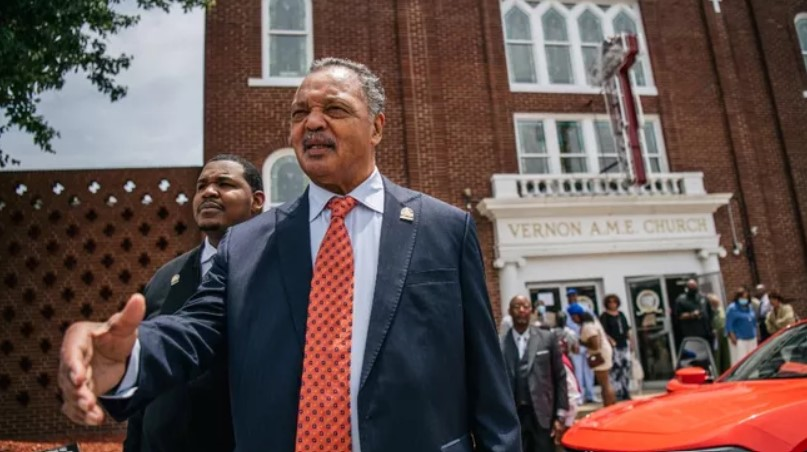
Rev. Jesse Jackson died during the morning hours of Feb. 17, 2026. He was 84 years old.
While the world remembers this civil rights icon for his fight to save humanity and for the way he centered his fight on the plight of Black folks, Jackson’s unique love and pride for Detroit meant something far more meaningful for its people.
Jackson was born in Greenville, South Carolina in 1941 and moved to Chicago – a city much like Detroit – as a young man in the mid-1960s in his 20s, but the Motor City will fondly remember a man who had walked its picket lines, filled its churches, chastised its corporate boardrooms, and embraced its contradictions. For this city, Jackson was more than a presidential candidate or television orator. He was a regular presence in moments of crisis and possibility, and a man who came here to PUSH.
PUSH – the name he gave to Operation PUSH in 1971 and later expanded through Rainbow PUSH Coalition – wasn’t just an acronym or poetic jargon from a preacher. It was an ethic. People United to Save Humanity.
In Detroit, PUSH carried a literal meaning. It meant pushing automakers to hire Black workers and make cars that were affordable for Black residents. It meant pushing banks to lend in Black neighborhoods. It meant pushing elected officials to protect the city’s most vulnerable. It meant pushing a nation to see the humanity in a majority-Black city too often reduced to headlines about crime or bankruptcy.
Jackson understood Detroit as a symbol and as battleground for Black liberation across the country. The Motor City was the arsenal of democracy, the home of the assembly line, the forge of the Black middle class. It was also the site of disinvestment, redlining, and industrial flight. He knew that if Black workers could secure a foothold here – in the plants of General Motors, Ford Motor Company, and Chrysler – then the promise of economic justice might become tangible.
“We don’t need diversity, we need equality,” Jackson declared during one of his Detroit visits tied to automotive industry negotiations, a line the Michigan Chronicle carried prominently. In a city where “diversity” often meant token appointments while Black workers bore the brunt of layoffs, Jackson’s words landed with force. Equality meant contracts. It meant supplier diversity with teeth. It meant Black dealerships and Black vendors beyond symbolic gestures, and as structural participants in Detroit’s economic engine.
Detroit’s relationship with Jackson was layered: sometimes harmonious, sometimes tense. The city has never lacked its own civil rights leadership. Figures like the late Arthur L. Johnson and Horace L. Sheffield Sr., and the formidable Rosa Parks carried moral authority rooted in local struggle. The towering presence of Coleman A. Young, Detroit’s first Black mayor, reshaped the political landscape in ways that were at once transformative and controversial. Jackson entered that ecosystem as both ally and outsider as a Southern preacher with national ambitions stepping into a city fiercely protective of its own.
There were seasons when Jackson and Young stood shoulder to shoulder, particularly when federal policies threatened Detroit’s economic survival. Both men understood the language of confrontation. Both believed in leveraging power rather than pleading for it. Yet there were moments of friction. Detroit politics have always been intimate and intense, and Jackson’s national Rainbow Coalition sometimes clashed with local calculations. The Chronicle covered those tensions without flinching, recognizing that movements, like cities, are rarely monolithic.
For instance, in 1973, Jackson offered his support to Young as he was making a push to become Detroit’s first Black mayor. Someone from Young’s staff told Michigan Chronicle in 1973 that Jackson asked for $70,000 a week to help with the campaign. Jackson said that he didn’t need the money, but that he had to pay his staff. Young declined the offer in a way that Young typically declined offers (vehemently and in an animated way), but Jackson showed up in solidarity weeks before the early November vote and helped Young defeat John Nichols by a three percent margin. In later elections, Jackson would put the full weight of his endorsement behind Young.
But when auto jobs hung in the balance, Jackson returned to the city with singular clarity. During the auto industry crises of the late 2000s, as bankruptcy loomed and layoffs rippled through Black neighborhoods, Jackson called on national civil rights groups to intervene.
“Detroit is not just your city; it is the soul of industrial America,” he said, urging organizations and policymakers alike to treat the survival of Detroit’s workforce as a moral imperative. Those words were an echo of PUSH and a demand that the country recognize that what happened to Black workers on the line reverberated far beyond Michigan.
Jackson’s advocacy for Black auto workers was tangible. He pressed automakers to expand minority dealer programs and supplier contracts. Through Rainbow PUSH’s annual conventions in Detroit, he summoned corporate executives to public accountability sessions, asking them to report their numbers: How many Black managers? How many contracts with Black-owned firms? How many advertising dollars spent in Black media? Detroit’s auto industry executives grew accustomed to those questions. Jackson did not ask them quietly in private meetings. He PUSHed them in public.
For Black Detroiters who had migrated from Alabama, Mississippi and Georgia to work in the plants, Jackson’s presence felt familiar. He spoke their language with biblical cadences woven into labor statistics. He could pivot from quoting scripture to citing unemployment rates. And always, he returned to hope, even in the hardest seasons.
“If you’re behind in a race, you can’t run equally,” he said during his 1984 presidential campaign, words that resonated in union halls and church basements alike. Detroit knew what it meant to start behind.
His presidential campaigns in 1984 and 1988 were watershed moments here. Rallies on the city’s west side and gatherings in downtown churches drew multiracial crowds, but it was Black Detroit that formed the backbone of his support. The Rainbow Coalition message – that farmers, factory workers, the poor and the marginalized shared common cause – found fertile ground in neighborhoods shaped by both union strength and racial segregation. Jackson’s near-victory in the Michigan primary in 1988 signaled the seriousness of his candidacy and the political muscle of Black voters in this state.
Yet even as Detroit embraced Jackson’s national aspirations, it also measured him against its own icons. The city’s activists didn’t curtsy before his charisma. (Afterall, every Detroiter feels like an influencer in their own right.) They asked hard questions about strategy, about follow-through, about the balance between national spotlight and local grind. There were times when local clergy felt overshadowed by Jackson’s star power, times when grassroots organizers debated whether Rainbow PUSH’s interventions complemented or complicated their work. The Black press documented those debates as family conversations that were often intense but rooted in shared stakes.
Jackson’s connection to labor placed him in dialogue with the United Auto Workers, a union with a complicated racial history. He challenged the UAW to deepen its commitment to Black workers even as he praised its role in building the middle class.
In Detroit, where union membership was often the difference between stability and precarity, Jackson’s willingness to PUSH both corporations and labor leaders underscored his independence. He was not content with symbolic solidarity. He sought measurable change.
The bankruptcy era tested that resolve. As Detroit filed for municipal bankruptcy in 2013, and retirees feared for their pensions, Jackson warned against balancing budgets on the backs of the vulnerable.
He framed the crisis beyond fiscal mismanagement. He framed it as the cumulative result of disinvestment and structural inequality. Detroit, he argued in interviews and speeches, deserved restructuring without humiliation. It deserved partnership, not punishment. PUSH, in that context, meant resisting narratives that cast the city as disposable.
Jackson’s critics in Detroit sometimes questioned whether his interventions were too theatrical, too rooted in the language of protest rather than policy. But even they conceded that his presence drew national attention to local fights. When he convened executives under the Rainbow PUSH banner, cameras followed. When he marched, headlines followed. In a media ecosystem that frequently made a caricature out of Detroit, that visibility carried weight.
There is poetry in the way Jackson’s life intersected with this city.
Detroit itself is an acronym of sorts. It’s a shorthand for resilience, reinvention, and resistance. Like PUSH, it is a word that implies motion. You push through layoffs. You push through plant closures. You push through emergency management and water shutoffs. You push because standing still is not an option.
Jackson’s theology of hope resonated here because it did not deny suffering. “Keep hope alive,” he would say – a refrain that Detroiters adopted as discipline.
Hope, in his framing, was not passive.
It was organized. It was registered to vote. It was unionized. It was seated at negotiating tables demanding contracts and capital.
In Detroit, hope looked like Black engineers in auto design centers, Black entrepreneurs in supplier diversity programs, Black families holding onto homes in neighborhoods long redlined.
At times, Jackson’s relationships with Detroit leaders were strained by the ego and ambition of himself and others’. This city has always produced strong personalities. But beneath the friction was a shared understanding: the fate of Black Detroit was inseparable from the broader Black freedom struggle.
When Jackson PUSHed automakers to increase minority dealerships, he was also PUSHing against centuries of exclusion. When he demanded advertising dollars for Black newspapers, including this one, he was affirming that narrative power is economic power.
The Michigan Chronicle covered Jackson as engaged participant. We chronicled his visits to the North American International Auto Show, his meetings with executives, his sermons in local churches. We also chronicled the debates, the questions from activists who wanted deeper structural commitments, the skepticism from those wary of national figures parachuting in. That is the work of the Black press: to honor, to question, to contextualize.
In the end, Jackson’s Detroit story is not reducible to harmony or discord. It is a story of PUSH, and pushing means that sometimes things are aligned, and sometimes things are contested, but pushing means that there’s always a forward-moving agenda.
Jackson’s Detroit story is of a preacher who saw in the assembly line as human aspiration. It is the story of a city that demanded more than rhetoric and often received both rhetoric and results.
Now, as Detroit reflects on his passing, the word PUSH lingers. People United to Save Humanity. In this city, it also meant People United to Save the plants, to Save pensions, to Save neighborhoods from foreclosure. It meant pushing power to recognize Black labor as indispensable. It meant pushing ourselves to vote, to organize, to build.
Jesse Jackson did not belong to Detroit alone. But Detroit shaped and sharpened his mission, just as he amplified the city’s struggles on a national stage. His voice rang out in union halls and corporate boardrooms, in sanctuaries and on sidewalks. Sometimes welcomed warmly, sometimes received warily, but never ignored.
In the Motor City, that may be the truest measure of his legacy. He came here to PUSH. And whether in triumph or tension, Detroit felt the force of that push toward jobs, toward dignity, toward a more equitable share of the prosperity its Black workers helped create.