

By Rita Cook
Correspondent
Texas Metro News
WASHINGTON, D.C. – A storm hitting two states and leaving massive damage does not play the game of politics.
That is why there is something uncomfortable about watching two states hit by the same storm and Washington responding differently to each one.
Disaster relief: damage or politics?
I am offering food for thought, not facts. You decide.
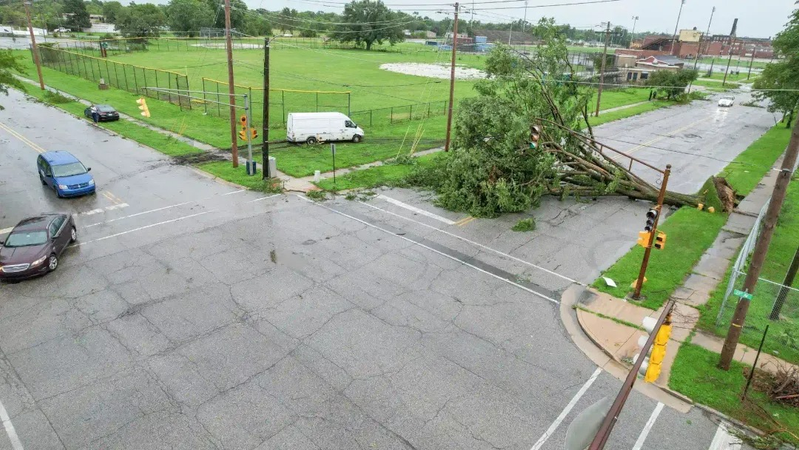
On August 11, a powerful derecho ripped through parts of the Midwest with tornadoes, flooding and widespread power outages across Indiana and Illinois.
At its height, more than 600,000 customers across the two states lost power. In Illinois alone, more than 58,000 homes and businesses were without electricity the following day.
In Gary, Indiana, the aftermath was particularly brutal, with the city among the hardest-hit communities and thousands of residents still without power nearly two weeks later.
President Donald Trump approved an emergency declaration for Indiana on August 15, allowing federal resources to supplement the state’s response. A major disaster declaration followed, making additional federal assistance available to affected Indiana residents and communities.
Indiana Gov. Mike Braun welcomed the federal response and promised residents, “I will do everything in my power to protect Hoosier lives and livelihoods.”
No problem.
Except Illinois was hit by the same storm.
Illinois, however, did not receive a comparable federal emergency declaration following the August 11 storm, even though the same storm system battered communities across the state.
And that is where this stops being simply a story about bad weather.
It becomes a question about Washington.
To pull this back on a larger scale, an AP analysis found that the Trump administration approved 80% of disaster requests from Republican governors but about 60% from Democratic governors, with Democratic-led states generally waiting longer for decisions.
That doesn’t prove political favoritism, but it certainly makes me ask the question:
WHY?
A faster federal response in Indiana does not, by itself, prove political favoritism.
But it is also fair to ask whether the rules are being applied consistently — and what was the hold-up in Illinois.
Illinois officials and Democratic leaders had every right to ask why federal assistance appeared to move more quickly for Indiana while communities across the state line faced a more uncertain wait for comparable help.
And this isn’t the first time Illinois has found itself on the wrong side of federal disaster relief.
Earlier this year, the Trump administration rejected Illinois’ request for federal disaster assistance related to an August 2025 storm, rejecting the state’s request for a second time in February.
Again, none of this proves political favoritism.
But it certainly deserves scrutiny.
It is true that federal disaster money isn’t handed out because somebody asks nicely. There are assessments, thresholds, documentation and a process that determines whether the federal government will step in.
So, the question for Washington is simple:
Are all standards applied equally?
The damage is the damage.
And the people standing in the middle of it are Americans first.
The federal government is supposed to serve Americans, not sort them into red states and blue states before deciding who gets a helping hand.
A disaster should be measured in wind speed, water and damage — not political affiliation. Because when the lights go out, nobody cares what color the state is, they just want the lights turned back on.
Rita Cook is a world traveler and writer/editor who specializes in writing on travel, auto, crime and politics. A correspondent for Texas Metro News, she has published 11 books and has also produced low-budget films.

