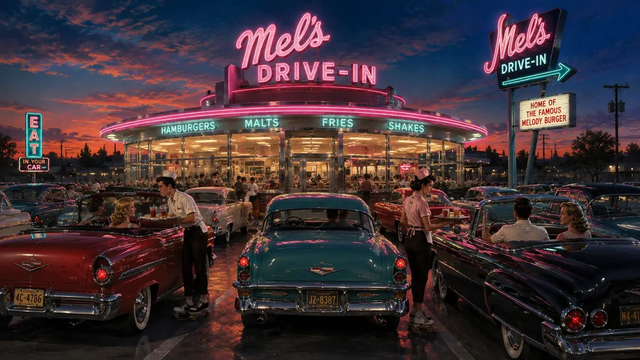
Three August twenty-sixths when American culture expanded — its democracy, its media, and its capacity for a certain kind of perfectly calibrated popular joy.
August 26 is a day for American firsts that arrived, in each case, later than they should have. In 1920, the Nineteenth Amendment was officially certified as part of the Constitution, extending the right to vote to women — a right that had been denied to half the population for the republic’s entire 144-year existence, and that the suffragist movement had fought for with remarkable persistence through decades of legislative defeat, public ridicule, and organized resistance before finally succeeding. Nineteen years later, in a Brooklyn ballpark, a television camera pointed at a
baseball diamond for the first time and transmitted the game to the handful of people who owned television sets in 1939, beginning a partnership between
sport and the emerging medium that would transform both. And in 1978, a soundtrack that mixed 1950s nostalgia with late-1970s pop sensibility climbed to the top of the charts a second time, cementing the cultural reach of a film that had already become one of the defining popular artifacts of its decade. Three August twenty-sixths. Three moments when America became, in some small or large way, more of what it had claimed to be or what it wanted to be.

The 19th
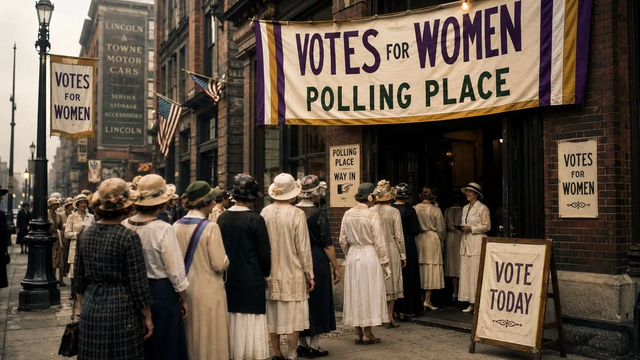
On August 26, 1920, Secretary of State Bainbridge Colby signed the proclamation certifying the ratification of the Nineteenth Amendment to the United States Constitution, making it the law of the land that the right of citizens to vote shall not be denied or abridged on account of sex. The amendment had been submitted to the states for ratification on June 4, 1919, and the final push to the required thirty-six state ratifications had come down to Tennessee, where the state legislature voted on August 18, 1920 — with the decisive vote cast by twenty-four-year-old Representative Harry Burn, who had received a letter from his mother urging him to support ratification and changed his vote accordingly. The signing on August 26 completed a process that had been underway since the first women’s rights convention at Seneca Falls, New York, in 1848 — when Elizabeth Cady Stanton and Frederick Douglass and others had declared that women’s suffrage was a fundamental democratic right. Seventy-two years had passed between that declaration and the amendment’s certification.
The Nineteenth Amendment certified on August 26, 1920, was the largest single expansion of the American electorate in the country’s history, more than doubling the number of eligible voters overnight. Its passage was the product of a movement that had employed every available tool — petition campaigns, demonstrations, hunger strikes, lobbying, political organizing, and the deliberate cultivation of public sympathy — against an opposition that included not only male-dominated legislatures but also organized groups of women who believed that women’s suffrage was unnecessary or undesirable. The victory was also incomplete: the amendment’s text prohibited denial of the vote on the basis of sex, but many of the women who had fought for it — Black women, Indigenous women, women who were not citizens — remained disenfranchised by other laws and practices. The full realization of the promise of August 26, 1920, required the Voting Rights Act of 1965 and the Twenty-Fourth Amendment and decades of additional struggle. The amendment signed on that date was a beginning, not an end — but it was one of the most consequential beginnings in American political history.
Ebbets Field, 1939
On August 26, 1939, NBC broadcast the first major league baseball game ever transmitted on television — a doubleheader between the Brooklyn Dodgers and the Cincinnati Reds at Ebbets Field in Brooklyn — using a single camera positioned behind home plate, operated by NBC engineer Burke Crotty, and reaching an estimated 400 television sets in the New York area. The broadcast was announced by Red Barber, who described the action while working largely without the visual aids and replay technology that would define sports broadcasting for later generations. The picture quality was primitive — the image small, the contrast difficult, the camera unable to track the ball with any reliability — but the principle had been established: a baseball game could be transmitted through the air and received in a living room, changing the relationship between the game and its audience in ways that no one in 1939 could fully anticipate.
The broadcast at Ebbets Field on August 26, 1939, was the seed of what became the most lucrative partnership in the history of sports. Television rights to major league baseball are now worth billions of dollars annually; the visual culture of the game — the camera angles, the slow-motion replays, the statistical overlays, the color commentary format that Barber helped invent — has shaped how Americans understand and experience the sport more thoroughly than any other medium. The 400 people who watched the first televised game on their primitive sets in 1939 could not have imagined that the technology in their living rooms would eventually pay every player’s salary, fund every stadium, and define every fan’s primary relationship with a game that had previously been experienced only in person or on radio. The camera that NBC pointed at Ebbets Field on August 26, 1939, set all of that in motion.
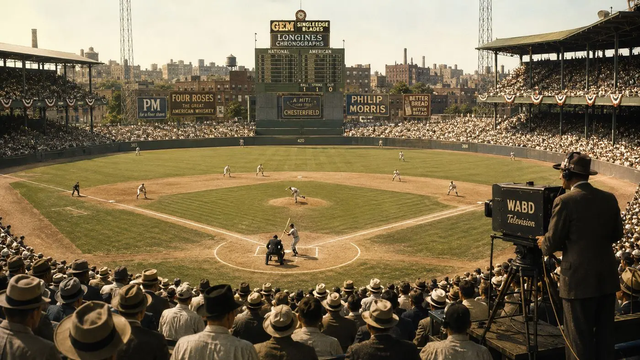
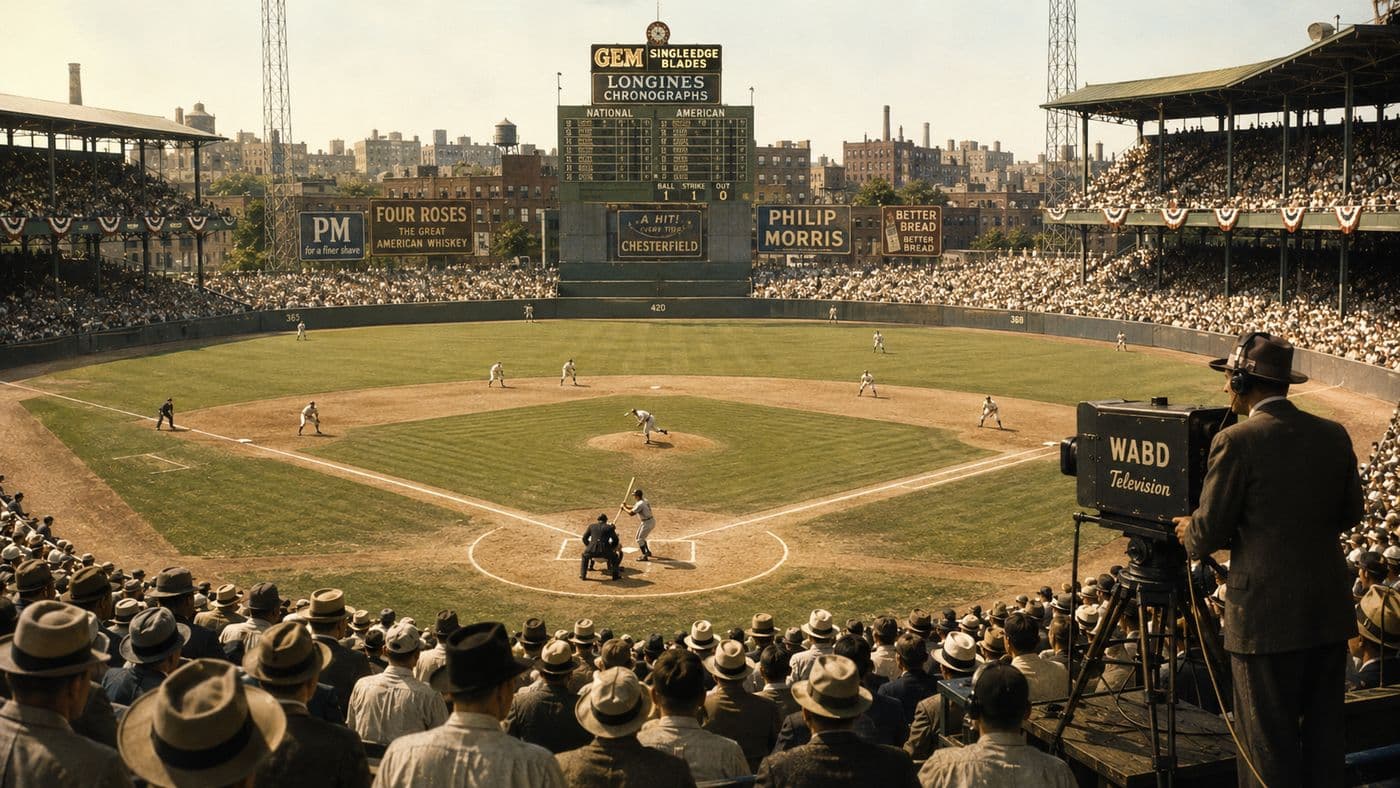
Ebbets Field, Brooklyn, August 26, 1939 — where a single NBC camera behind home plate transmitted the first major league baseball game in television history to approximately 400 sets in the New York area.
On August 26, 1978, the Grease soundtrack album achieved its second number one position on the Billboard albums chart — a measure of the extraordinary commercial reach of a film that had opened in June 1978 and spent most of the summer dominating both the box office and the radio. Grease, directed by Randal Kleiser and starring John Travolta and Olivia Newton-John, was based on a 1971 stage musical that had romanticized the 1950s for a 1970s audience; the film version updated that nostalgia for a late-1970s sensibility and produced a soundtrack that blended period-inflected rock and roll with contemporary pop production in ways that proved immediately and almost universally appealing. The soundtrack generated multiple hit singles, including “You’re the One That I Want” — a number that Travolta and Newton-John recorded specifically for the film, which was not part of the original stage show — that spent nine weeks at number one in the United Kingdom and became one of the best-selling singles in history.
The Grease soundtrack’s return to the top of the Billboard chart on August 26, 1978, was evidence of a cultural phenomenon that went beyond ordinary film success. The album became one of the best-selling soundtracks in music history, eventually selling more than 28 million copies worldwide. The film it accompanied grossed more than $395 million against a budget of approximately $6 million, making it one of the most profitable films in Hollywood history at the time. Its influence on the cultural representation of the 1950s — on what subsequent generations imagined that decade to have been like — was profound and arguably not entirely accurate, presenting a version of American teenage life that was considerably more sanitized and romantically resolved than the actual 1950s, or for that matter the actual 1970s that produced the film. What Grease offered was something more durable than accuracy: a soundtrack to a particular feeling about the past, which is why the songs on it have never entirely gone away.