The MS NOW host opens up about finding her place in Washington and why she believes the country needs a serious conversation about the future of American democracy.
By Okla Jones
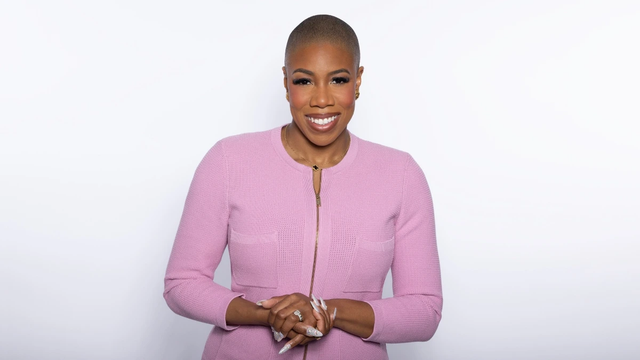
If there’s one thing Symone Sanders Townsend has never struggled with, it’s finding something to say. The former White House advisor has made a career out of speaking her mind, a quality that has earned her recognition in Washington and helped establish her presence on national television. Her experience working inside the government gives her a perspective that viewers don’t often get from traditional news coverage. Now, as a journalist, she brings that knowledge to her reporting, offering insight into how decisions are made and what they mean for the people affected by them.
In recent years, keeping up with politics has become exhausting for many Americans. The constant stream of breaking news can make it difficult to distinguish what deserves attention from what will be forgotten by tomorrow. It’s an environment in which the Nebraska native’s conversational style feels particularly suited to the times. As co-anchor of MS NOW’s The Weeknight, she brings an unmistakable personality to news coverage, an approach that carries over to Clock It with Symone & Eugene, her weekly podcast with longtime friend Eugene Daniels. The network is also expanding its relationship with viewers through the recently launched MS NOW Membership, which offers live discussions with journalists and opportunities for audiences to ask questions directly. The initiative has included in-person events, beginning with a live edition of The Weeknight in Dallas featuring Symone and her co-anchors.
Sanders Townsend’s transition from strategist to media personality has brought a different set of responsibilities. Her experience offers a valuable perspective as Americans navigate growing divisions and questions about the credibility of the institutions they depend on for information. With another election cycle approaching, the need for independent reporting remains as pressing as ever.
In a conversation with ESSENCE, Sanders Townsend discusses her latest projects, reflects on the experiences that have influenced her career and shares her thoughts on the state of journalism and American politics.
ESSENCE: I wanted to start with the Clock It podcast. What inspired you and Eugene Daniels to create it, and what were you guys trying to accomplish with that particular series?
Symone Sanders-Townsend: It’s so funny. The idea for the podcast actually came when I was still working on the weekends, when I co-hosted The Weekend and when Eugene was still at Politico. And he had done the show one morning, and after the show, we’re sitting in my office with my senior producer, Brittany Ruff, who is now a senior producer on the podcast, and we’re just in there talking. And Brittany said, “Y’all should have a podcast.” And I said, “Really? Do you think anybody wants to hear this?” And we thought we should have a podcast. And so we went to the folks at the network, Madeline Herringer, who is the guru at MS NOW for all things digital, long-form and audio. And she liked the idea. So we went through months of development, and this all happened last year. So it seems like it’s quick, but we’ve been talking about this since, I would argue, maybe last summer. Went through a lot of different development ideas. And the original idea of the podcast, which I think we are still true to today, is that politics and culture aren’t separate. What is happening in culture leads politics. Culture is politics, and politics is, in fact, a part of the culture.
It’s not that people aren’t paying attention to what’s happening in politics. I fully reject that. All my non-political group chats seem to actually know what the hell is going on. What the problem is, I think, was out there, and I think the evidence is borne out in what we hear from people when we see them out in the real world, as I like to say, is that sometimes people are not discussing the events of the day, the politics and the culture, in a way that is accessible or understandable or like they would talk about it. And so when you tune into Clock It, Eugene and I, this is an actual conversation we would have. We are actually friends. When people are joining the group chat, this week, who joined the group chat was Mayor Brandon Scott of Baltimore, whom I know very, very well. Me and Mayor Scott came up together at the same time. He is somebody who is literally in one of my group chats. And so when we’re talking, the familiarity is there, but we’re also giving you the facts and helping people unpack what is going on and go a little deeper. Honestly, it was only supposed to be an eight-episode series, and then we just kept going. And then they put podcast equipment in our homes, and now we are on the cusp of, by January, we’ll be a year into Clock It. It’s really amazing.
For someone who wants to become politically aware but may be struggling with where to start or may feel overwhelmed, what steps would you advise them to take?
SS: Well, one, I would advise them to sign up for Clock It. So wherever you get your podcasts, we’re also on YouTube at ms.now/clockit. But two, I think two things. One, most people, and there’s some new Pew research that actually just came out yesterday, that talked about the fact that more and more people are getting their news from their phones, from the device in their hand. So, I would encourage people to follow the news organizations on social media and then some of the reporters or journalists or hosts that you’ve seen that you like, go ahead and give them a follow. Because I’m somebody that I’m going to give you your fashion content and my nails and the lashes, but I’m also going to give you some political commentary in my stories or on my TikTok or as I tweet a little bit. But I’m on Threads now.
I would argue I’m very good at it, but I’m not unique. And I think that increasingly, news organizations, especially at MS NOW, have understood that you have to meet people where they are. And so I don’t think folks have to… Obviously, I would love to say tune into The Weeknight, but one of the easiest entry points, if you’re somebody that’s just like, “Look, I’m overwhelmed. I see what’s going on, and I want to be a little bit more informed, especially because an election is literally around the corner as we talk. It’s about 10 days away.” And so go ahead and click the follow on the social media sites that you’re already on.
I want to talk about MS NOW. How did you initially connect with them, and why do you think MS NOW is more important than ever currently?
SS: I came to MS NOW after I left the White House, and I had a bunch of meetings when I left with all of the news organizations, honestly. MS NOW, then called MSNBC, the former president of the network, I met with her. I said, “I want to have a show.” And she said, “What kind of show would you like to have?” And the other executives that I met with at the other networks, they all tried to talk me out of it. They’d say, “Oh, you don’t really want a show,” or “Isn’t that too much of a lift for you? Don’t you want some flexibility to do something else?” Or someone flat-out told me that “nobody’s going to give you a show.” Well, MS NOW took a chance on me, and I would argue it was a really great bet. And so I used to have my own show called Symone at 4:00 pm, and then we went to the weekend, and then we went to The Weekend, which was Saturdays and Sundays in the morning, and now we are very excited that we are at 7:00 pm on The Weeknight, every night in folks’ living rooms.
And what I love about what we do, and frankly, what I love about the folks that watch us, is that for the people that watch us, we have a very loyal viewer community because when they come, they’re coming to hear what we, the hosts, have to say. Sure, they might enjoy a great guest. We always endeavor to have great bookings and the newsmakers, but they’re coming to hear what me, Michael and Luke have to say on The Weeknight. I was just in my kitchen watching Steph Ruhles. People who are tuning into Money, Power, Politics, they want to hear Steph’s take on the business and the money and what’s really going on with Wall Street and why the billionaires aren’t doing more because Steph really knows it because this is what she used to do. She’s so knowledgeable, and she’s personable in the way that she delivers it.
And so what I love about what we are doing right now is that we have our finger on the pulse of what’s happening out there, especially when it relates to politics. We’re not one of the news organizations that is kowtowing or backing down. I have never sat in a meeting with the executives where they have told me not to say something or I cannot say something. I think in this day and age, that’s very important. I am excited about what we do on The Weeknight every night, because you’re going to learn something on our show, and you may feel concerned, but you would’ve got a laugh out of it. And I think at the end of the day, you’ll feel good about it. And that is a privilege, frankly.
The last thing I’ll say is that it is a tough time for journalism. And journalists have a target on their backs. Obviously, news organizations across the country, frankly, are not being funded at the levels that they should. Local newspapers are closing. My mother owns the oldest Black newspaper in Nebraska, the Omaha Star. And so it is a very tough time for journalism, but this is the most important time because, as I talked about, we talk about how people are getting their news from social media sometimes, and sometimes they’re clicking on creators, sometimes they’re clicking on folks like me or the actual news organization’s websites. But if they’re clicking on a creator, to be very clear, the creator is getting their information from a story that a journalist went out and reported. Somebody at MS NOW is on the ground on our national security beat or out in these campaigns, or our White House reporters that are doing the reporting, that are writing the articles, that are putting the information out there for the creators and the people on the internet to absorb and then repeat out there to the world. And so journalism is vitally important, especially with a government that wants to tell you one version or their version of a story. I feel really blessed to be able to do this work right now, especially in this time. Every day it’s like you have to laugh to keep from crying, but this is, I think, a pivotal moment. When I look back on this moment in our history, I will feel great about what I will be able to say about what we did here at our network, what I did to contribute to the national conversation and to really just talk about and talk honestly about what is happening in this country right now.
You’ve built a career in spaces where Black women haven’t always had a seat at the table. What has been the biggest challenge you’ve faced in making your voice heard throughout your career?
SS: I think that’s such a good question because for what I would call the first part of my career, I was a habitual campaign staffer. I ended my political career as a strategist, but I started off as an organizer. I was an outside organizer. And it was interesting because I was oftentimes the youngest person in the room and sometimes the only person of color, literally the person of color, period. I’m originally from North Omaha, Nebraska, and my first big race that I worked was while I was in college, and I worked for my mayor. They were trying to recall the mayor. So I went to work on the mayor’s campaign to beat the recall, and I met these guys who were consultants that they had hired out of Tennessee. It was a Black-owned firm. It was Chris Smith and Robert White, and they had hired them to organize North and South Omaha, the predominantly Black and Latino parts of the city. And when the campaign was over, we beat the recall, but the mayor lost reelection two years later because the writing clearly was on the wall. They let me continue to work with them while I was still in school.
And that experience was actually very formative for me in terms of understanding my voice. I worked on judges’ races. They flew me out to go with them when they would do the candidate analysis meetings where these candidates or potential candidates were deciding if they were going to get into the race, and this particular firm had done the research, and they’re presenting. It wasn’t just me watching. I was taking notes. And that is where I really learned, one, you got to pay attention. Two, you got to do your research. But three, if you are not speaking up or engaging in the conversation, there’s no way that what you think can change anything. I took those lessons into all of the additional work that I’ve done. And honestly, some days I am shocked because somebody like me, a little bald Black girl from North Omaha, Nebraska, is not supposed to make it to the highest echelons of American politics. I am not supposed to be sitting in primetime television every night. I’m not supposed to be someone that can call up presidents and senators and some prime ministers, but I’m not supposed to occupy a position of power, somebody that looks like me and who comes from where I’m from.
That’s amazing to hear.
SS: But the fact that I do is a testament, frankly, to not me, but I really think to the community around me and these amazing opportunities that I’ve had throughout my career. I guess I’ll end this answer with saying, not that speaking up has always been easy because it’s always difficult, but I have always prioritized going into a place where my voice is valued, and that sometimes is risky because in my professional career, I have had to make decisions about where I’m not going to go or somewhere that I need to leave or a contract I was not going to take because I didn’t feel like my voice was going to be valued. And that is a tricky tightrope to walk. It has been throughout my entire career. But looking back on it, I really feel like prioritizing a place where my voice was valued, not that my voice was the most important voice in the room.
On Senator Sander’s campaign in 2016, it wasn’t that my voice was the most important voice in the room, but Senator Sanders valued what I had to say. He sought my counsel. He asked me what I thought, and when I gave him a response, he would listen to it. Also, the reason I went to work for then-Vice President Biden’s presidential campaign in 2020 is because, one, I felt like had the clearest case, and he understood the case he was making, but two, he really valued my voice, and I was really shocked by that. I met him at his home. We were only supposed to be meeting for about 20 minutes. I ended up being at the house for an hour and a half. He gave me a tour. We were talking, and we were very frank and candid. And so the way that you and I are speaking right now, how I talk on Clock It, how people see me speaking when I speak on television, that’s how I used to talk to all these candidates and senators and presidents. And Vice President Harris used to tell me that one of my greatest qualities. Now, I could be speaking to the vice president of the United States of America. I could be speaking to a business leader. I could be speaking to a young person that is coming into some event or something we’re doing. I could be speaking to a member of Congress that’s coming on our show tonight, but I’m going to meet the people where they are. And frankly, at the end of the day, we are all just people trying to have a conversation.
Your book, Don’t Say I Didn’t Warn You, has an amazing title. What inspired you to write this?
SS: I’m literally in the middle of writing the book right now. My manuscript is due December 1st, and so this book can get out in fall of 2027. I found myself increasingly frustrated. I think people that watch our show know that multiple times a week, they are like, “I’m concerned.” But I found myself frustrated because I think that the diagnosis of what went wrong in our politics with the pro-democracy coalition, not just the Democratic Party, but the pro-democracy coalition, what people should do versus the conservative movement in this country, I just feel like the analysis was so flat. And I was so frustrated because going into these midterm elections in advance of the next presidential election, I think we got to make sure we’re having the right kind of conversation. We have to be honest about what’s going on.
And for all the people that are like, “Well, Democrats don’t necessarily have the right message,” or “It’s the issues. People don’t care about the issues.” I don’t think America has a values problem because most people, Democrats, Republicans and independents, agree that people should have healthcare. At this point, everybody agrees gas is too damn high. They agree that childcare is too expensive. Most people agree that housing should be affordable and that their elected officials should do something about it. So the issues that people on the side of the pro-democracy coalition are putting forward are not issues that aren’t popular. I reject that. The problem is power. And so my book is called Don’t Say I Didn’t Warn You: America Has a Power Problem because before people cast a ballot in the primary for the next presidential election and then in the general election, I think people need to be very, very clear about what the issue is.
The issue isn’t that the conservative movement has figured out something that the rest of us haven’t and that they’re just so much more crafty. They haven’t. They literally copied the civil rights movement. I have a chapter in my book called “They Copied Us.” They saw how specifically Black Americans changed the culture of this country through the courts, through advocacy and activism, through elected officials, through legislation. And they saw that, and they copied it. They copied the machinery. They didn’t copy what it was for. And I think that the people in the pro-democracy coalition need to remember that. We talk about Dr. King and the Voting Rights Act in 1965 and the Civil Rights Act of 1964 and the March on Washington, but we reduce them to these legislative wins and a really great speech. We don’t talk about the strategy that went behind it. We don’t talk about the fact that there were some arguments and fights. It’s like we forgot how we got those things.
And so I wanted to write this book, and I wanted it to be out before anybody has to cast a ballot because there are just, I think, some frank conversations that I think we try to have on The Weeknight every night, but I had a lot of thoughts, so I needed to put them in a book. So it’s not a values problem. America has a power problem. And I think that the pro-democracy coalition people in this country need to get more serious about power. But it’s not just power for power’s sake. I talk about power for whom and power for what? And then when you get power, what are you going to do with it? What are you prepared to do? So I’m very excited about it, and I can’t wait for people to read what I’ve been working on.