

By Kathia Woods
The Philadelphia Tribune
https://www.phillytrib.com/
Photos courtesy Philadelphia Museum of Art
For nearly 150 years, the Philadelphia Museum of Art has quietly practiced something many institutions are only now catching up to: telling American art history as one story, not several segregated ones.
That philosophy is on full display in “A Nation of Artists,” the museum’s sweeping reinstallation of its American galleries and part of a collaboration with the Pennsylvania Academy of the Fine Arts. In a recent conversation, curators Alexandra Kirtley (decorative arts) and Kathleen A. Foster (paintings and sculpture) explained how and why it came together.
Asked why Black artists were woven into the broader American narrative rather than given a separate exhibition, the curators were direct saying this isn’t new, and it isn’t reactive — it’s museum policy going back generations.
Henry Ossawa Tanner’s “The Annunciation,” acquired in 1899 is “one of the very first pieces of contemporary art the museum ever purchased,” Foster said. It’s hung in the middle of the other painting galleries, no special treatment, no separate wing. So is the Edgefield face vessels, stoneware pieces made by formerly enslaved artisans in South Carolina and acquired in 1904, now recognized as foundational to the study of American ceramics.
The through-line, Foster said, is a “principle of simultaneity,” showing what was happening in American art at a given historical moment, across mediums, across makers, all at once.
That’s also why the museum still resists a designated “Black art gallery” or “women artists gallery,” Foster explained. Instead, the work is scattered throughout the collection, findable with a rack card at the admission desk that points visitors to where Black artists’ work appears across the museum.
Foster was careful to separate two distinct moments. The first is the reinstallation of the museum’s first-floor early American galleries (roughly 1650s–1840s), in planning since around 2016 and finally opened to the public in May 2021. Built to integrate the work of Native American, African American and women makers rather than isolate it, the reinstallation was ready to debut just as the pandemic shut the museum’s doors and just as the murder of George Floyd sparked a national reckoning over representation.
“We have got the installation that America needs,” Kirtley recalled telling herself, stuck at home with a finished project she couldn’t open. The galleries didn’t reopen until spring 2021.
The second milestone is “A Nation of Artists” itself. The second-floor galleries covering roughly 1830 to 1960, the era when the museum’s collection of Black artists’ work “really got strong,” Foster said. That exhibition opened earlier this year, five years after the first-floor reopening, the culmination of the same long-term curatorial project, carried upstairs and given its own name.
So while 2020 is a real hinge point in this story, it’s the moment the world caught up to work the museum had already been doing quietly for years. It accelerated and validated a philosophy already in motion rather than sparking one from scratch.
Kirtley recalled a patron assuming the museum must have scrambled to rewrite its wall labels after 2020. The answer was no: “We were there, and we were pushing that envelope that the rest of America suddenly opened up to.”
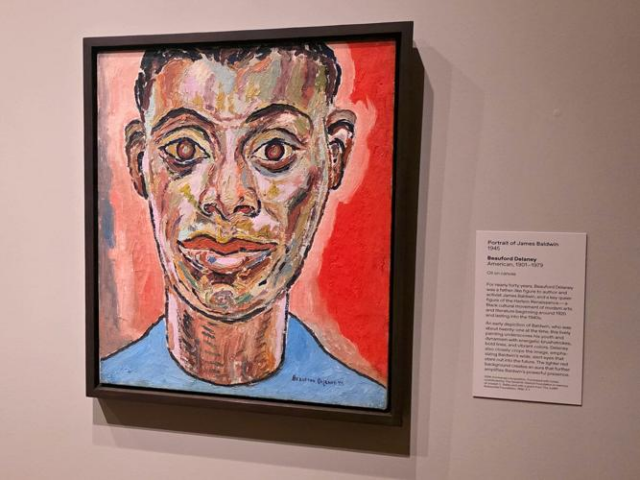
Deciding what goes into a gallery, Foster explained, is part scholarship, part education-department input. The department tracks what actually gets school groups talking, which is why Beauford Delaney’s radiant “Portrait of James Baldwin” and Horace Pippin’s “Mr. Prejudice” are permanent fixtures. And part of it is more personal: pieces curators have hunted for years and finally landed.
That list includes a long-sought Edward Bannister watercolor and, more dramatically, a sculpture by Meta Warrick Fuller — a North Philadelphia native and graduate of the museum’s own school, and a guiding figure of the Harlem Renaissance — acquired at auction just last year after the museum had zero examples of her work in the collection. Curators from rival institutions, Foster noted with some satisfaction, are chasing the same names.
The show also includes a loaned Robert Duncanson buffalo-hunt painting, which Kirtley singled out as under-appreciated. The museum, despite years of trying, has never managed to acquire a Duncanson of its own.
“A Nation of Artists” isn’t confined to the Benjamin Franklin Parkway. It’s a two-venue collaboration between PMA and PAFA, America’s first art museum and school Founded in 1805, PAFA is built around the private Middleton Family Collection and timed to the nation’s semiquincentennial. Where PMA moves chronologically through 1700–1960, PAFA takes a thematic approach, threading historical work into dialogue with contemporary artists.
Lea C. Stephenson, PAFA’s curator of historical American art, told the Philadelphia Inquirer that the field’s old definition of an “American artist” required being born or working in the U.S., a definition she says the show has “moved beyond” in favor of a more inclusive narrative that folds in immigrant, Indigenous and artists of color.
Foster made much the same point about PMA’s own galleries in her conversation with the Inquirer, rejecting the idea of a single American style. “There is no American style,” she said. “There are a multitude of ways to be American.”
Kirtley, too, tied that plurality back to the absence of a royal court or national academy to dictate taste in the U.S. Without a single patron class setting the standard, she told the paper, “there isn’t a single taste because there’s not a single tastemaker.”
At PAFA, that idea plays out literally on the wall: an 1883 portrait by Boston-born Charles Sprague Pearce hangs beside Chinese American artist Hung Liu’s 2004 painting “Visage II,” both depicting East Asian figures. Stephenson said the pairing exists to “interrogate” questions of cultural appropriation and exoticism rather than take the term at face value.
Toward the end of a tour through the PAFA galleries, the idea surfaced again in a different register — each room felt less like a settled account of history than an open question posed to the viewer. Stephenson liked that framing. Per the academy’s website, the show isn’t built to hand visitors a tidy verdict on what American art is, but to keep unsettling it, gallery by gallery, letting historical and contemporary works talk back to one another.
“I always think of it as multidimensional, hybrid,” Stephenson said. “There is no singular narrative of American art. And there is no singular chronological timeline.”
Pressed on how to define “American art” when the category spans painting, pottery, quilts and photography, the curators leaned into the messiness rather than resolving it.
“It’s a little bit of everything, shaped by where you’re from and who raised you,” Kirtley said.
The exhibition’s title is doing philosophical work of its own: a nation is not one culture but an umbrella over many states, communities and traditions that stayed insular alongside traditions that blended into something new. Trained academy painters hang beside self-taught ones, enslaved and free, immigrant and Indigenous, side by side, deliberately.
The museum is more than its famous steps, the curators emphasized it belongs to all of Philadelphia.
“The building carries a piece of that story,” Kirtley shared. “Its primary architectural drawings were done by Julian Abel, a Black architect working in the firm of record, a history the museum plans to spotlight in a 2028 exhibition timed to the building’s centennial. Abel’s great-nephew, also an architect, returned to open the American galleries in 2021.”
The curators described the museum less as a temple for the wealthy than as “the attic of the city” —150 years of art collected largely by and from Philadelphians, meant to reflect the neighbors, ancestors, and grandmothers of the people walking through the door. Per Kirtley, attendance is climbing again after a rocky few years, with “A Nation of Artists” drawing more than 120,000 visitors so far.
Asked for their own favorite pieces in the show, both curators reached past the marquee highlights.
Foster said it’s a Daniel Garber’s portrait of his daughter in a studio doorway, a painting she first studied decades ago as a young curator and never stopped loving. Kirtley named the loaned Robert Duncanson buffalo-hunt scene, adding that it’s “still not getting the attention it deserves.”
“A Nation of Artists” is on display at the Philadelphia Museum of Art through July 5, 2027, and at the Pennsylvania Academy of the Fine Arts through Sept. 5, 2027.

