By Terrance Turner and Chelsea Lenora Small
The Forward Times
https://www.forwardtimes.com/
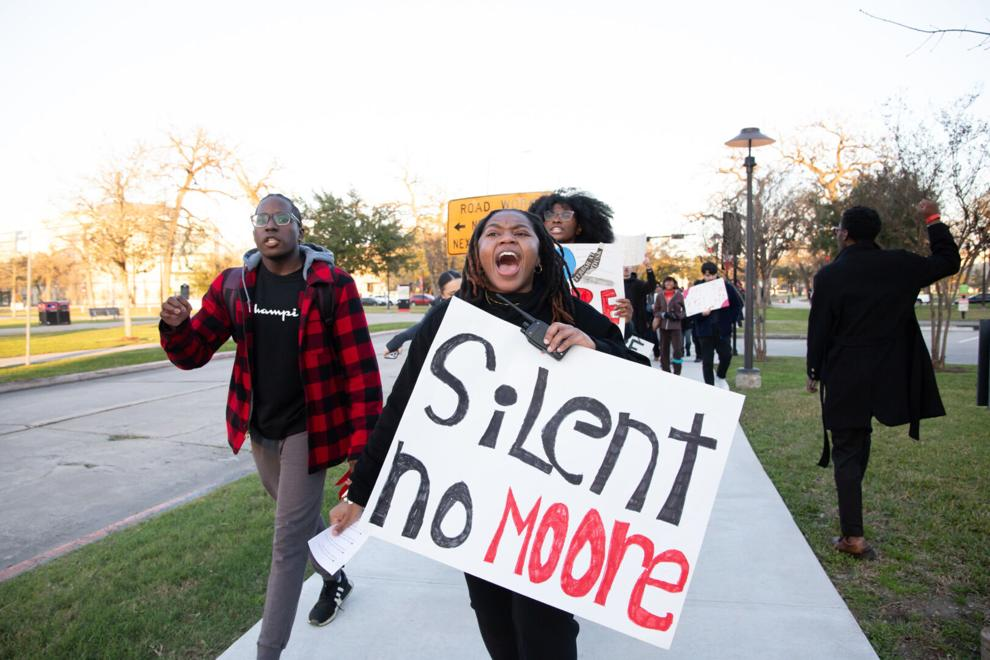
The 100th anniversary of Black History Month arrives at a moment when protest once again defines the national conversation.
Across America, and here in Texas, students are walking out, families are organizing, and communities are raising their voices. In Houston, protest appears to be unfolding along two distinct but familiar tracks: local injustice and federal overreach.
On Feb. 12, students and parents gathered outside Lantrip Elementary School in Houston’s East End to protest the state takeover of Houston ISD, a controversial intervention that began in 2023 when the Texas Education Agency replaced the district’s elected school board with a state-appointed superintendent and board of managers. Students boycotted classes as part of a “sickout,” a coordinated absence from school intended to demonstrate dissent, organized by the advocacy group Community Voices for Public Education.
The protest came amid renewed tensions following a recent announcement that the district plans to close or consolidate 12 campuses next school year, a move critics say reflects the broader erosion of local control under the takeover.
Days earlier, on Feb. 4, roughly 100 students at Sam Houston’s Math, Science and Technology Center rallied, calling for the release of their classmate. Eighteen-year-old Mauro Henriquez, a Houston ISD student and captain of the school’s soccer team, is in the custody of U.S. Immigration and Customs Enforcement. His family says that, despite having filed an asylum claim seeking legal protection in the United States, Mauro and his father, neither of whom have criminal records, were detained on Dec. 16 and have been held at ICE’s Montgomery Processing Center in Conroe.
The response has been swift. In Austin, students within Round Rock ISD and Austin ISD have walked out in protest of ICE’s actions. Texas Gov. Greg Abbott has ordered the Texas Education Agency to investigate the walkouts. The TEA has threatened to revoke certifications of instructors who assist in the protests and has raised the possibility of replacing elected school boards with boards of managers, a scenario Houston ISD families know all too well.
While the headlines feel immediate, the pattern is not new.
Student protest has long been one of the most powerful engines of change in American history. In Houston, that history is not theoretical. It is documented in the pages of this newspaper.

From Sit-Ins to SNCC
To understand the present, one must revisit 1967.
To understand 1967, one must go back even further.
In April 1960, activist Ella Baker helped organize the Student Nonviolent Coordinating Committee, known as SNCC. Born out of the Greensboro sit-ins, SNCC became a youth-led force committed to direct action such as sit-ins, strikes, and boycotts to dismantle segregation.
On Feb. 1, 1960, four Black students sat down at a Woolworth’s lunch counter in Greensboro, North Carolina, and refused to leave until they were served. The protest spread.
On March 4, 1960, 13 students at Texas Southern University staged their own sit-in at a Weingarten’s grocery store lunch counter at 4110 Almeda Road. Though mocked and harassed, they persisted. Others joined them. By August of that year, Houston quietly desegregated its local businesses.
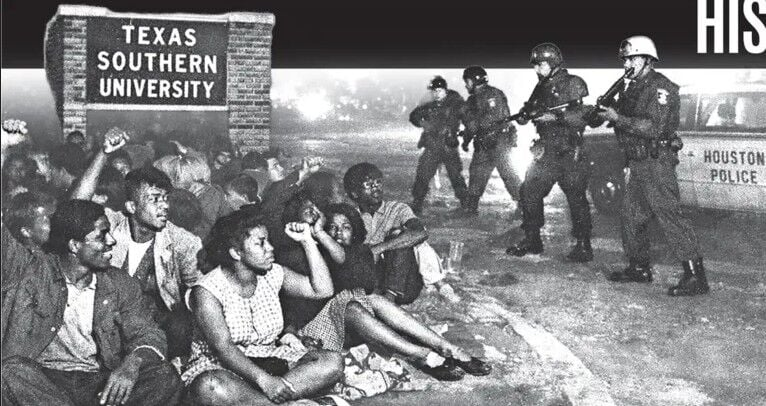
By 1967, a SNCC chapter known as “Friends of SNCC” had formed on TSU’s campus. In March of that year, students began demonstrating over inadequate campus food conditions, early curfews, and the lack of courses such as engineering and technology, according to the Freedom Archives.
Campus administrators responded by removing the SNCC chapter from campus and dismissing faculty adviser Mack Jones, who had written a scathing editorial on the state of TSU education. On March 20, 1967, SNCC was told to meet off campus, and Jones was informed that his contract would not be renewed.
Students rebelled.
More than a thousand walked out of classes on March 28, gathering on the steps of the main building and singing freedom songs, according to Forward Times writer Artice Vaughn. They demanded higher teacher salaries, curfew reform, and improved cafeteria food.
The protest worked, but only in part. Campus administrators extended curfews and revised dorm hours. SNCC was reinstated on campus, though Jones was not. The chapter gained three new faculty advisers, one of them white.
Yet unrest did not subside.
The Convergence of Protest
In April 1967, former student Lee Otis Johnson, SNCC co-chair Frederick Douglass Kirkpatrick, and Franklin Alexander of the W.E.B. DuBois Clubs were arrested in connection with the growing campus protests and broader demonstrations taking place across Houston. TSU students marched to the Harris County Courthouse in protest.
Then tragedy struck.
On May 8, 1967, 11-year-old Victor George drowned in a trash-filled pond at Houston’s Holmes Road Dump near Reed Road. Residents had long argued that the dump had been intentionally placed in a segregated Black neighborhood. Citizens demanded that Houston Mayor Louie Welch close it. The city sealed the pond but did not shut down the dump.
Protests expanded.
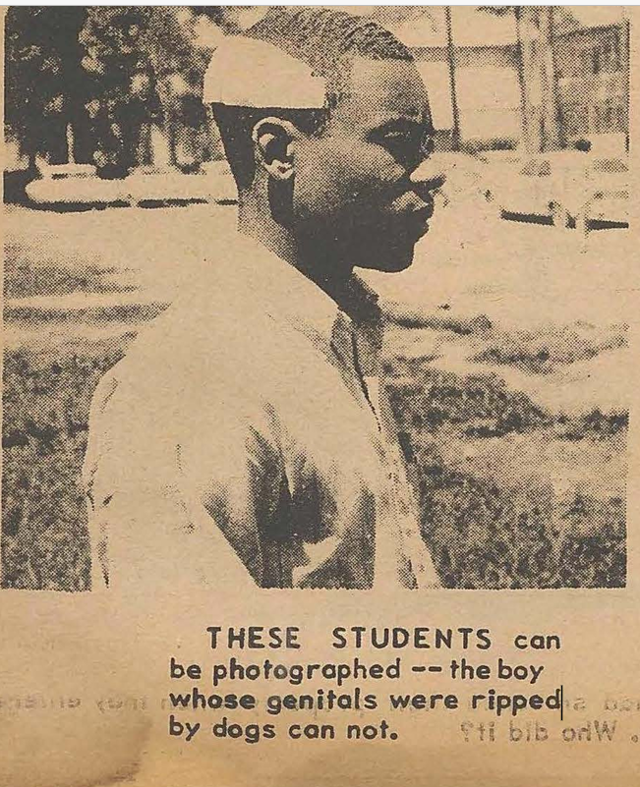
Frustration mounted in Northeast Houston after 16 Black students were expelled from Northwood Junior High School following a fight with white students but were not readmitted when the white students returned. Demonstrations intensified in Sunnyside over Victor George’s death.
By May 16, students from Houston-area high schools and colleges joined community members in both protests. Police arrested approximately 60 demonstrators.
The next day would change the city.
May 17, 1967
“I was one of the arrested Sunnyside protesters,” wrote the late Rev. William A. Lawson in the May 27, 1967 edition of the Forward Times.
Lawson was not simply a protester. He was the founding pastor of Wheeler Avenue Baptist Church and a central figure in Houston’s Civil Rights movement. He helped raise funds to bail out TSU students after earlier sit-ins and welcomed Dr. Martin Luther King Jr. to Houston when other churches would not. He was also a regular contributor to the Forward Times, using this very platform to speak truth to power.
Arrested late on May 17 during the demonstrations, Lawson was released shortly after midnight at the request of Mayor Welch, who hoped he could help calm escalating tensions at Texas Southern University.
Lawson rushed to the campus. He arrived too late.
Police had blocked Wheeler Avenue. Officers with drawn weapons faced the dormitories. What began as protest over policy escalated into gunfire.
Former TSU Student Advisory Committee President Shelby Kyles wrote that students piled debris between the freshman dorm and the coffee shop and set it ablaze. Police advanced. Shots were fired.
Kyles, a former combat infantryman, recognized the sound of weapons.
“For a period of five minutes, I could have been in a bunker in Vietnam,” he wrote. “I heard a ricocheting bullet hit the concrete in front of me.”
More than 5,000 rounds were fired that night, according to accounts. Officer Louis Kuba was killed. Five students, later known as the “TSU Five,” were arrested. It was ultimately determined that Kuba was killed by friendly fire, a ricochet from police gunfire.
Police arrested more than 480 students, many uninvolved in the protest. Students were forced from their dorms, some in pajamas and underwear, and ordered to lie face-down on the ground.
“They made me lie on my stomach and one policeman walked on me,” said dorm matron Mrs. Mattie Harbert in an interview with the Forward Times. She described broken property, bloodied students, and medical attention denied.
The images from 1967 feel disturbingly familiar.
Protest as Preservation, Progress, and Power
Today’s students protest state takeovers, immigration enforcement, police brutality, environmental injustice, and systemic inequity. As in 1967, official responses often invoke “law and order,” framing protest as disruption rather than dissent.
There are other parallels as well. Just as students who were not involved in the 1967 protests were swept up in mass arrests and brutality, recent headlines have highlighted the killing of individuals such as Renee Good during immigration enforcement actions, even though she was not protesting. When the state responds with force, its impact is rarely confined to the protest itself.
What lessons endure?
1. Be prepared to pivot.
The student protests of 1967 did not remain confined to cafeteria food and curfews. They expanded to confront environmental injustice and discriminatory school discipline. The issues converged because injustice rarely travels alone.
Today’s students similarly connect education policy to immigration enforcement, policing practices, and economic inequality. Movements evolve as communities recognize how systems intersect.
2. Hit them where it hurts.
Economic pressure remains one of the most effective tools of protest. Boycotts during the Civil Rights Movement forced businesses and institutions to respond when moral appeals alone did not.
Today, economic organizing continues through divestment campaigns and consumer accountability. Communities can track which corporations support policies viewed as harmful and which institutions retreat from equity commitments. Some of those companies appear in the NAACP’s Black Consumer Advisory.
The strategy is familiar. Power often listens when profit is affected.
In 1967, Houston students, faith leaders, and citizens refused to be silent. Their protests confronted racial inequity, challenged state authority, exposed environmental injustice, and demanded accountability from institutions that had long gone unchecked. Forward Times documented every step and remains committed to preserving the record as each new generation defines its own movement.
One hundred years into Black History Month, the lesson remains clear.
Protest is not chaos.
It is preservation.
It is progress.
It is power.
And as long as injustice adapts, so will those willing to stand against it.