Antong Lucky and Jack Matthews’ Mill City development finally begins to take shape.
By Robert Wilonsky
Dallas Morning News
https://www.dallasnews.com/

Robert Wilonsky
The flat, white building at 3719 Spring Ave., where it meets the dead-end Ashworth Avenue in South Dallas’ Mill City neighborhood, used to be known as the S&S Food Mart — purveyor of “Groceries Snacks Cold Drinks Cigarettes,” as the storefront used to say. About a decade ago, it turned into Doc’s Corner Mart. Today, or sometime soon, at least, it’s Ourbucks Coffee.
Yes, you read that right: Ourbucks. There’s a sign in the parking lot, too: “MORE THAN COFFEE,” it reads in green. Beneath, in black, it says, “WE’RE A COMMUNITY.”
The round, green logo looks familiar, too. Except in the place of the twin-tailed siren synonymous with a certain Seattle-based brand, there’s a Black woman with an Afro.
When I first drove past Friday afternoon I thought maybe this was some art installation, like the Prada storefront in Marfa. But when I U-turned and got out of the car, I saw the coffee makers perched on the counters inside and the permits posted in the windows, along with the rezoning signs planted out front and along Ashworth.
I recognized the name on the permits: Antong Lucky, the former gang member turned activist whose name is mentioned whenever city officials need someone to curb violence in historically underserved neighborhoods. He knows this part of town as well as anyone, having split his childhood between his grandparents’ house on Frazier Street, which intersects with Spring less than half a mile away, and his mom’s place in the old Frazier Courts projects on Spring and Hatcher Street razed 20 years ago.

Robert Wilonsky
“I have dual citizenship,” Lucky told me this week. “It’s all Mill City, East Dallas, but you still had those invisible barriers. Me and my family had the benefit of being able to roam all over.”
Last time we spoke was five years ago, when Lucky and his mentor, Urban Specialists founder Bishop Omar Jahwar, were summoned to Dallas City Hall and Jahwar told the City Council that “violence stays over some communities like a cloud, and it needs a good wind to brush it away.”
Eight months after that, in October 2020, Jahwar was hospitalized with COVID-19. He died the following May. A year ago, Lucky erected on a vacant lot next to the Ourbucks a statue of his mentor. There’s an inscription on its base: “Only inspired people can inspire people.”
Lucky said the coffee shop, which will include a kitchen for neighborhood bakers who want to sell their goods at Ourbucks, was supposed to open months ago, but that it was delayed by, among other things, “contractors who were screwing us around.” But he said things are back on track: His first employee begins this week, tasked with hiring folks from the neighborhood and teaching them about coffee. An opening date has not yet been announced, Lucky said. But it’s close.

As it turns out, Ourbucks is only a small piece of the larger Mill City 50 development taking shape in the neighborhood that sits less than a mile from Fair Park’s fences. On nearby Sutton Street, which dead-ends into a canal, are eight new 1,600-square-foot houses built by Good Urban Development LLC — a 50-50 partnership that includes Lucky’s Urban Specialists and Matthews Southwest, so named for its president and founder, developer Jack Matthews, the Canadian who has seemingly built (or rebuilt) much of Dallas in recent years.
The houses, which run from $249,000 to around $325,000, went on the market just last week — delayed, like the coffee shop, because of work that needed to be reworked. Matthews and Lucky told me separately they delayed building for as long as they could, hoping the state Legislature would eventually cap property taxes for longtime residents of gentrifying neighborhoods. Eventually, Matthews said, that never even got close.
“At the end of the day, it became more of a Republican-Democrat thing,” he said. “Even though we had supporters from each party pushing for it.” Eventually they went ahead with building, he said, because “life gets better and you get more developers out here when you do. Paying it forward and giving back is a good thing. It’s not a moneymaker deal. Now, we’re trying not to make it a money-loser. But that’s what it’s about.”

Robert Wilonsky
The rezoning signs are the next step in the makeover, as Lucky and Matthews look to build more homes and a boxing gym adjacent to the coffee shop. Long story short, Lucky said of the project that received $2 million from the city and $2.5 million from the county via American Rescue Plan Act funds: “We’re working to connect all that stuff together and make Mill City a neighborhood again.”
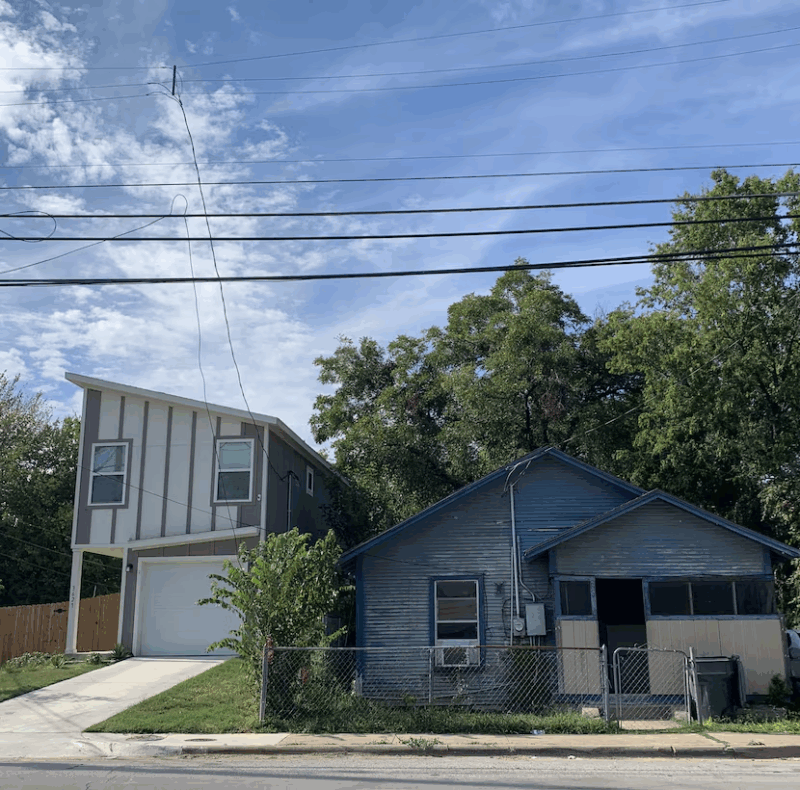
Which, it goes without saying, won’t be easy: Spring Avenue alone is sprinkled with random new builds alongside neglected, occasionally boarded-up rental houses owned by out-of-towners from Plano, Waxahachie, Lancaster and points even farther. Some blocks along streets like Metropolitan and Penelope have been completely remade in that stark shade of white-box; others are filled with weary apartments and tumbledown homes.
Like many South Dallas neighborhoods, Mill City is in a state of … transition, let’s say, as nonprofits and developers and LLCs vie for parcels of land worth dollars on the penny compared to just a decade ago.
I walked the neighborhood a few times this week and met lifers worried about being priced out. I met a young woman in a 4-year-old house whose realtor told her in 2021 this neighborhood would be remade within the decade. And I spent time at an old biker bar on Spring called Willie G’s that nowadays looks more like an East Austin tiki-themed hangout.
Robert Wilonsky
On Monday, Wilson Pickett’s unbearably funky “Mini-Skirt Minnie” was blaring from the picnic tables at Willie G’s. I visited with Robert Walker, who keeps an eye on the place during the week. He was stamping golf balls as he talked about houses going for $375,000 closer to Fair Park and about how it was getting expensive to live in South Dallas.
In his 2022 book A Redemptive Path Forward: From Incarceration to a Lifetime of Activism, Lucky wrote about how he’d always wanted to “develop South Dallas into an attractive neighborhood where families thrived.” Three years later, that vision comes a little further into focus in a part of town to which too many have turned a blind eye for too long.
“I come from that neighborhood, and 25 years later I still deal with the reputation, the stereotypes, the judgement of coming from that neighborhood,” Lucky said. “I tell people that won’t stop, but that you can make anything happen, that anything is possible. Adversity, hiccups, bumps in the road are part of the process — embrace them, stay focused. You can come from the neighborhood and add to what you hope this neighborhood can be in the future.”
Robert Wilonsky is Dallas Morning News editorial columnist.
This story, originally published in The Dallas Morning News, is reprinted as part of a collaborative partnership between The Dallas Morning News and Texas Metro News. The partnership seeks to boost coverage of Dallas’ communities of color, particularly in southern Dallas.