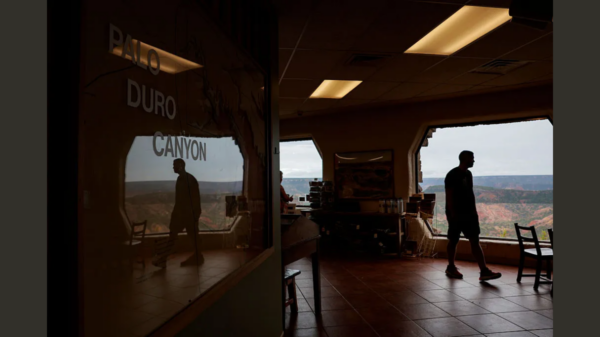
A federal hearing on the new maps continues this week.

Stephen Spillman / AP
EI PASO — A federal hearing continues this week on whether to halt or affirm Texas’ controversial new congressional map, with the decision by the three-judge panel potentially affecting redistricting efforts across the country.
The data surrounding this summer’s redrawing of Texas’ congressional districts leaves little doubt that the new map dilutes the voting strength of minority residents in urban areas in order to net Republicans five more U.S. House seats.
Is it legal?
The federal panel is expected to decide whether to issue a preliminary injunction against the map.
During the first four days of the hearing, plaintiffs’ lawyers argued Texas Republicans intentionally discriminated against minority voters through racial gerrymandering. Lawyers for the state, who will present their case as early as Monday, have countered that the development of the controversial map was about partisan politics, not race, and that partisan map drawing — even when it affects minority voters — is legal.
Voting rights analysts contend redistricting questions were clearer before courts began chipping away at protections for minority voters under federal laws and the Constitution. Redistricting issues are still evolving, and this case is the latest step in a legal fight that will likely reach the U.S. Supreme Court.
The outcome of this struggle could profoundly affect redistricting efforts not only in Texas but also across the country. If map drawers have a way to legally create racially gerrymandered districts, it could mean the further erosion of protections under the federal Voting Rights Act.

Eric Gay / AP
“If we were talking about this 10 years ago, legislators wouldn’t have even drawn the map because they would have known that it would have been rejected by the courts,” said Rice political scientist Mark Jones, who has studied redistricting issues. “Minority voters do not appear to have that same level of protection today, and the Republican mapmakers took full advantage of that. The only reason that Republicans were able to get close to their target of five seats was by getting rid of or significantly altering at least two, if not three, coalition districts.”
Jones said voting rights and redistricting issues are at a critical juncture, as minority voters across the country could be gerrymandered. There would be no distinction between voters of color who once were victimized by discrimination and anyone else.
“Much of the debate will revolve around whether race and ethnicity was the driving factor in drawing the maps or whether it’s partisanship,” Jones said. “Regardless of where you fall on that argument, what’s clear is that there will be a negative impact on minority voters. Even if you claim partisanship, you’re still significantly reducing the ability of Latino voters and Black voters to elect candidates with their choice.”
State Rep. Matt Shaheen, R-Prosper, who is chairman of the House Elections Committee, said he was confident the new congressional boundaries would stand.
“I think they’re excellent,” Shaheen said. “These new seats are a better representation of the demographics in the state of Texas.”
Shaheen said the new maps create more minority districts, which was a source of debate during the hearing.
Legal prelude to Texas redistricting
Several recent court rulings have changed the way voting rights laws are being interpreted.
The Rucho vs. Common Cause case involved the redistricting of North Carolina congressional districts. In 2019, the U.S. Supreme Court ruled that the maps, which gave North Carolina Republicans a solid majority in the state’s delegation to Congress, were legal.
In reversing a lower court’s ruling that the redistricting plan was unconstitutional, Chief Justice John Roberts wrote in the 5-4 majority opinion that “partisan gerrymandering claims present political questions beyond the reach of the federal courts.”
In her dissent, Justice Elena Kagan countered “of all times to abandon the Court’s duty to declare the law, this was not the one. The practices challenged in these cases imperil our system of government.”
The Supreme Court decision laid the foundation for states like Texas to claim that their boundaries, no matter how distasteful to some, are based on partisan politics and not race.
In Petteway vs. Galveston County, the U.S. Fifth Circuit Court of Appeals in 2024 overturned a lower court decision and ruled that the federal Voting Rights Act doesn’t allow racial and ethnic groups to combine population in claims related to voter dilution. The U.S. Supreme Court is expected to hear an appeal of the ruling.
The case, which centered on whether the voting rights of Galveston County Black and Hispanic residents were violated, weighs heavily in the Texas congressional map case that’s before the El Paso three-judge panel.
The plaintiffs’ case so far
The crux of the plaintiffs’ case laid out last week is that Texas Republicans, led by Gov. Greg Abbott, targeted minority voters to achieve their political goals. The redrawing of the congressional boundaries, they argue, was prompted by a letter from the U.S. Department of Justice urging the state to dismantle what’s described as coalition districts. The basis of the Justice Department letter was the Petteway vs. Galveston County decision.
Written by Assistant Attorney General Harmeet Dhillon, the July 7 letter to Abbott and Attorney General Ken Paxton states that four congressional districts — three in the Houston area and one in Dallas-Fort Worth — violate the Voting Rights Act and the Constitution because they were drawn as “coalition districts” composed of a majority nonwhite populations. Three of those districts have long been held by Black representatives and one by a Latino member.
Abbott used the Justice Department’s warning about coalition districts as a reason to add redistricting to a special legislative session. In his proclamation, Abbott said he added redistricting to the special session agenda “in light of constitutional concerns raised by the U.S. Department of Justice.”
The governor also gave several media interviews saying the Department of Justice letter prompted him to call the special session.
During the hearing, plaintiffs’ lawyers replayed Abbott’s and Dhillon’s interviews discussing the need to end coalition districts. And they used Democratic lawmakers to reinforce the point.

Shafkat Anowar / Staff Photographer
“It was meant to spur that action, whether people wanted to do it or not,” testified state Rep. Joe Moody, D-El Paso, on the first day of the hearing.
State Sen. Royce West, D-Dallas, said the “process started when the state of Texas received the letter from the Department of Justice.”
West also testified that “minority communities were used as pawns as part of the redistricting process.”
“Look at the configuration of the map,” West said. “Minority communities were put in districts that represent rural interests.”
“This is what’s asinine about this, trying to construct a legal argument to say it’s about partisan politics. It’s not.”
North Texas’ District 33 was one of the targets in the Justice Department letter. Under the new lines, the district, represented by Rep. Marc Veasey, D-Fort Worth, was moved entirely out of Tarrant County.
Minority voters formerly in the district were packed into the heavily minority District 30 or moved into districts with rural power bases. At the same time, District 32, a Democratic stronghold since former U.S. Rep. Colin Allred flipped it from red to blue in 2018, was dramatically changed to include large swaths of East Texas. That means it would be an uphill battle for incumbent Rep. Julie Johnson, D-Farmers Branch, to retain the seat. If the map holds, Johnson said she will run next year in the new District 33.

Shafkat Anowar / Staff Photographer
Plaintiffs’ witnesses testified that the creation of two districts with Black voting age populations over 50% amounted to packing Black voters into those areas and removing the influence they had in other districts. Republicans are touting that the new boundaries include four Hispanic districts. Two in South Texas, one in Central Texas and one in the Houston area.
Matt Barreto, who leads a team at the UCLA Voting Rights Project that studied the Texas congressional maps, testified that the new congressional map upended majority-minority districts and deprived minority voters the ability to elect their candidates of choice. On Saturday, Barreto said it was impossible for Republicans to draw a map they produced — which gives them a shot at winning 30 out of 38 congressional districts — without intentional racial gerrymandering.
Abbott has used the creation of those districts to defend the new congressional map.
Under the previous map, Hispanics, who make up about 40% of the state’s population, were the majority in seven of the state’s 38 congressional districts. Now they are the majority in eight districts.
“Democrats think they have an ownership right to voters who are Hispanic or Black,” Abbott said during an interview. “They’re now learning the hard way those voters are supporting Republicans.”

Eric Gay / AP
In the two Houston-area districts and the San Antonio-area district, however, many experts say Hispanic voters will not be able to elect their candidate of choice. Though they are slightly over 50% of the population in those districts, they lack the eligible or frequent voters to win in a general election.
David Ely, founder of a firm called Compass Demographics, testified last week that new congressional boundaries diluted the Hispanic vote in those districts.
“It appears to be designed to be a pseudo-Hispanic-majority district,” Ely said of District 35 in central Texas that is represented by Rep. Greg Casar.
If the new boundaries are upheld, Casar will run next year in District 37, where he was paired with longtime Democratic incumbent Lloyd Doggett of Austin.
The state to present its case
Lawyers for the state sought to unravel the testimony from Democrats and plaintiffs’ experts by suggesting the redistricting effort was based on politics, not race.
The state is arguing that the notion of the Department of Justice letter being the only reason lawmakers redrew the congressional boundaries is false.
Defense lawyers also dug up statements plaintiffs’ witnesses made in the past about the partisan fight over the maps.
It was revealed under cross-examination that West had once called the redistricting effort a “naked power grab.”

Juan Figueroa / Staff Photographer
The distinction between partisan and racial gerrymandering is important because redrawing boundaries based on partisan political gain is largely legal.
When a defense lawyer asked if the process of redrawing the new maps amounted to partisan politics, West tried to give a nuanced answer. But Judge Jerry E. Smith pressed him to give a yes or no answer.
West said, “No.”
Later, West said, “No other districts were targeted,” West said. “Why just minority districts?”
In their questions, defense lawyers pointed out that Abbott and Dhillon were not members of the Legislature and could not force them into actions involving race.
Defense lawyers have argued in their filings that the Justice Department letter is flawed and incorrect and, regardless of its content, has no validity on the legality of the maps.
Plaintiff lawyers disagree and used last week to argue that the overall redistricting plan was developed with racial intent.
State lawmakers who testified were also asked if their Republican colleagues were racists.
No one answered yes.
This week, the defense will put on its case.
Adam Kincaid, the executive director of the National Republican Redistricting Trust and creator of the 2021 Texas congressional and legislative maps, is expected to testify. According to state Sen. Phil King, R-Weatherford, Kincaid was involved in developing the 2025 congressional map.

King, a Weatherford Republican and chairman of the Senate Special Committee on Congressional Redistricting, also is likely to testify. He has said the map was drawn for partisan purposes for Republicans to win more seats in Congress.
The defense might also call state Sen. Adam Hinojosa, R-Corpus Christi. Several demographic experts are also on their list.
The hearing is scheduled to end by Oct. 10.
The political stakes are enormous. Nationally, control of the U.S. House is in the balance. Historically, the party that controls the White House takes losses in midterm elections. Trump wants states to redraw congressional boundaries to improve the GOP’s chances of holding control of Congress.
“This is a once in a generation opportunity for five congressional seats to open up for one party,” said Vinny Minchillo, a political consultant who worked for Trump’s 2024 campaign. “Even if it ends up being just three seats, that’s a remarkable opportunity from a political standpoint. It’s really a demonstration of political power.”
The Howard University graduate and Chicago native has covered four presidential campaigns and written extensively about local, state and national politics. Before The News, he was a reporter at The Kansas City Star and The Chicago Defender. You can catch Gromer every Sunday at 8:30 a.m. on NBC 5’s Lone Star Politics.
This story, originally published in The Dallas Morning News, is reprinted as part of a collaborative partnership between The Dallas Morning News and Texas Metro News. The partnership seeks to boost coverage of Dallas’ communities of color, particularly in southern Dallas.