By Col. Richard Goldenberg
New York National Guard
Reprinted – by Texas Metro News
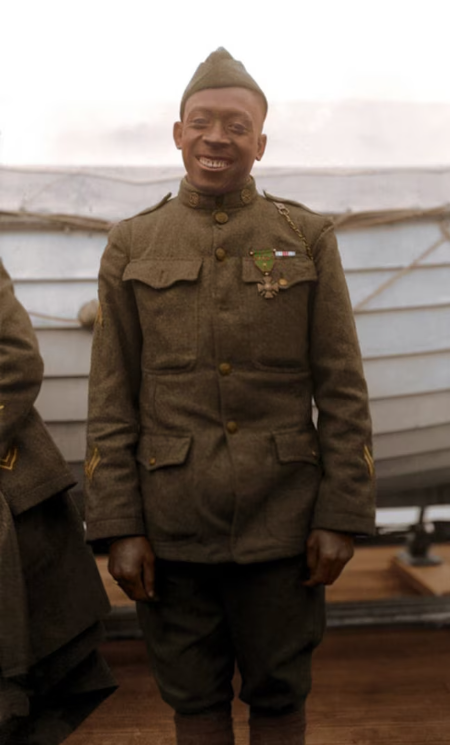
He was 26 years old, 5-foot-4, weighed 130 pounds, and came from Albany, New York. On the night of May 15, 1918, Pvt. Henry Johnson, a member of the all-black 369th Infantry Regiment, found himself fighting for his life against 20 German Soldiers out in front of his unit’s trench line. He fired the three rounds in his French-made rifle, tossed all his hand grenades, and then grabbed his Army-issue bolo knife and started stabbing. He buried the knife in the head of one attacker and then disemboweled another German soldier.
“Each slash meant something, believe me,” Johnson said later. “There wasn’t anything so fine about it,” he said. “Just fought for my life. A rabbit would have done that.”
By the time what a reporter called “The Battle of Henry Johnson” was over, Johnson had been wounded 21 times and become the first American hero of World War I.
Johnson’s actions during the night of May 15, 1918, brought attention to the African American Doughboys of the unit, the New York National Guard’s former 15th Infantry, re-designated the 369th for wartime service. The 369th Infantry, detached under French command, arrived on the front line trenches in the Champagne region on April 15, 1918. They were relieved to be free of the supply and service tasks of past months and ready to join the fight, now under the command of the French Fourth Army. The American Expeditionary Forces detached the all-black regiment to bolster an ally and preserve racial segregation in the American command.
The French were less concerned about racial inequality and welcomed the African American regiment that would earn its nickname as the Hellfighters from Harlem.
The regiment’s first battle would otherwise be a footnote in WWI history, fought by only two Soldiers, were it not for the scrutiny the all-black regiment faced at the time.
After weeks of combat patrols, raids, and artillery barrages, Pvts. Henry Johnson, 26, from Albany, N.Y., and his buddy Needham Roberts, 17, of Trenton N.J., from the regiment’s 1st Battalion, Company C, stood watch near a bridge over the Aisne River at Bois d’Hauzy during the night of May 15. An enemy patrol with an estimated 20-24 troops was determined to eliminate the outpost and bring prisoners back to learn about the all-black American force.