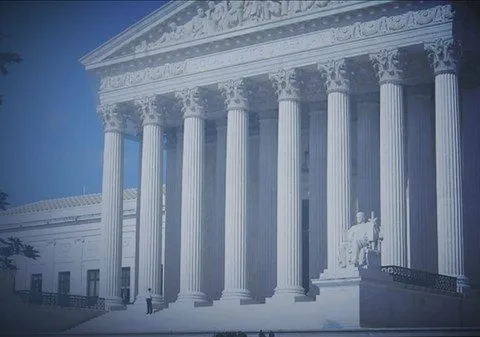
The U.S. Supreme Court is pondering a case in which prospective non-Indian adoptive parents and the State of Texas are challenging the Indian Child Welfare Act (ICWA). The ICWA (1978) sought to end generations of state policies that denied tribal sovereignty and forcibly removed Native children from their tribes.
The purpose of ICWA is to extend protections to children based on tribal citizenship, not racial status. However, authorities routinely dismiss the requirement to treat “Indian” as a citizenship category.
Instead, they consider them a racial group, even though the law defines an “Indian child” not in racial terms but as someone with a membership in or who is eligible for membership in a federally recognized tribe.
The ICWA requires that government actors treat “Indian” as a citizenship category whose boundaries are decided by self-governing Native nations. It has been lauded as a powerful assertion of tribal self-determination.
Congress passed ICWA in response to sustained tribal activism. In the 1960s and 1970s, tribal activists placed Indian child removal practices under the public microscope. Congress, after extensive hearings, enacted the law to stop generations of racialized policies that forcibly removed 25% to 35% of American Indian children from their communities, turning them over to White families and institutions for assimilation.
Agencies placed the children in institutions or families with no tribal connections. American Indians asserted that federal policy should honor the unique, sovereign status of tribes and ensure tribes could assume jurisdiction over child welfare cases involving their eligible members.
More than 500 Indian tribes see this case as a spearhead that could lead to other cases challenging Indian rights involving land, water, oil, mineral, and highly profitable gaming rights.
The court challenge
The State of Texas and several White families are challenging the ICWA in court. Texas asserts that the ICWA intrudes on state autonomy, and the families contend it is an unconstitutional racial classification.
A lawyer for the families argues that the ICWA categorizes children based on whether the children are Indian or not Indian, and then it categorizes prospective parents based on whether they are Indian.
In Oct. 2018, Federal District Court Judge Reed O’Connor struck down parts of the law as unconstitutional, claiming that it mandated racial preference. In Dec. 2018, the United States Court of Appeals for the Fifth Circuit ordered that O’Connor’s judgment be stayed, holding that it violated tribal sovereignty. On Aug. 9, 2019, the court ruled that the law does not violate equal protection. On Nov. 7, 2019, the court voted to rehear the case. The ICWA remains in effect.
Tribes’ constitutional status
Sociologist Hana Brown (2020) maintains that ICWA is a pivotal piece of federal Indian legislation. But she states that despite tribes’ constitutional status as sovereign political entities, the U.S. government interacted with tribes as domestic rather than foreign entities and engaged in campaigns designed to decimate tribes and assimilate indigenous people.
To facilitate this work, she revealed that the U.S. government pursued campaigns characterizing American Indians as racial minorities with pathological cultures, relying on racial ideologies to justify urban relocation programs, the forced sterilization of Native women, and other enterprises designed to undermine, if not destroy, tribal sovereignty and to facilitate the federal government’s seizure of Native lands.
Indian child removal and racialization
Brown (2020) argues that Indian boarding schools and child removals were part of a broader effort by the U.S. to undermine tribal sovereignty and facilitate the seizure of indigenous resources.
She found that administrative and juridical authorities routinely racialize American Indians and reconsolidate the racial order as they implement ICWA. State agents use the racial ideology that best serves their interests, not the interests of the racialized group, in deciding which populations constitute races or how to racially classify an individual.
She thinks that the concepts “citizenship” and “race” both refer to political creations, designed to divide populations and justify the unequal distribution of rights and resources.
Supreme Court plays race card against people of color
American Indian tribes fought for the Indian Child Welfare Act to protect Indian parental rights, tribal rights, and tribal sovereignty. It was enacted to defend the tribe against depopulation and the loss of resources.
Texas and other entities are attempting to weaken or annul the Indian Child Welfare Act. If the Supreme Court rules that the Act is unconstitutional, it will undermine the political gains made by Indians and embolden right-wing political groups to use race as a weapon against anti-racist policies such as affirmative action.
Dr. Luke Tripp is a professor at St. Cloud State University.